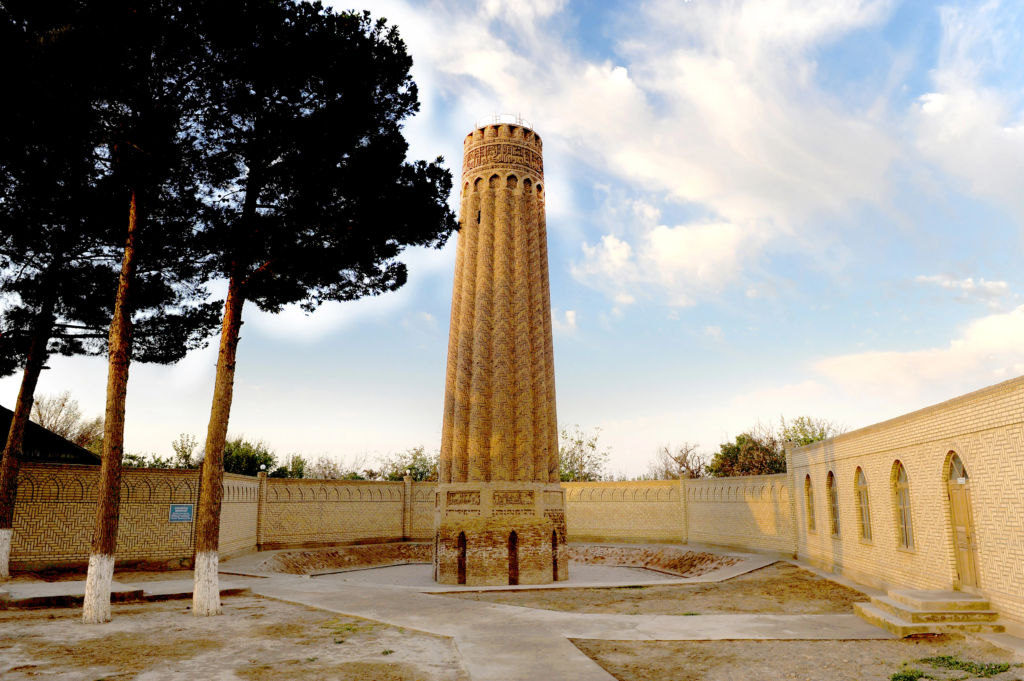
The Jarkurgan Minaret is one of the most distinguished monuments of medieval Islamic architecture in southern Uzbekistan. It is located near the village of Minor, approximately seven kilometers from Jarkurgan town in the Surxondaryo Region. Constructed in 1108–1109 AD, the minaret was built following the traditions of the Khorasan school of architecture, reflecting the architectural, cultural, and religious sophistication of the Seljuk period.
Adjacent to the minaret, there once stood a Jami mosque made of baked bricks, though it has not survived to the present day. The mosque and minaret together formed a religious, educational, and social center, serving as a hub for worship, study, and community gatherings. The combination of the mosque and minaret illustrates the integrated approach to architecture and community life during the Seljuk era.
During the reign of Sultan Sanjar, the Seljuk Empire reached a period of political stability, economic prosperity, and cultural flourishing. Cities became centers of trade, scholarship, and artistic expression. In this context, monumental structures like the Jarkurgan Minaret were built not only as functional religious buildings but also as symbols of Seljuk authority and devotion. Its unique fluted, or corrugated, design distinguishes it from other minarets in Central Asia, marking it as an exceptional achievement of medieval Islamic architecture.
French orientalist Paul Liferd observed that the Jarkurgan Minaret left a strong impression on Europeans due to its shape and style, noting its elegance and aesthetic sophistication. Indeed, the tower’s unique patterns, delicate ornamentation, and serene presence continue to captivate visitors.
The Seljuk period was marked by the fusion of architectural traditions from Iran, Khorasan, and the wider Islamic world. Minarets served multiple purposes: they called the faithful to prayer, represented political and religious authority, and showcased the region’s artistic achievements. The Jarkurgan Minaret exemplifies this combination of function, symbolism, and aesthetics.
The minaret occupies a prominent location within the Minor village, making it visible from a distance and symbolizing both Islamic faith and Seljuk authority. The mosque complex likely served as a center for religious education, where scholars taught the Qur’an, hadith, and Islamic jurisprudence. These educational and religious functions demonstrate the minaret’s role not just as a structural landmark, but as a focal point for cultural and intellectual life in the region.
Architecturally, the Seljuks experimented with innovative techniques. The combination of an octagonal base, decorative brickwork, and fluted shaft reflects both local and transregional influences. Such structures were intended to endure for centuries, serving as permanent markers of faith, power, and artistic achievement. The Jarkurgan Minaret demonstrates exceptional technical and artistic mastery.
The minaret is installed on an octagonal base, with each side containing arched niches. These niches provide both structural support and decorative rhythm. One of the niches houses a door that opens onto a spiral staircase leading to the interior gallery, allowing access to the upper levels of the tower.
The tower is topped with 16 fluted columns, which, when viewed from the base, appear to spread outward like an arc. This fluted design resembles a stylized fir tree or woven fabric, adding both elegance and structural integrity. The columns are connected with borders inscribed in Kufic script, giving the minaret a unique grandeur and decorative harmony.
The minaret’s bricks are arranged in a herringbone (“gofr”) pattern, creating a dynamic play of light and shadow on the tower’s surface. The precision of the brickwork demonstrates the high craftsmanship of Seljuk-era architects, while also reflecting their aesthetic sensibility.
Originally, the tower reached a height of 54 meters, though the top has not survived. Today, the minaret stands at 21.6 meters, with a base diameter of 5.4 meters. Its proportions create an elegant vertical emphasis and stability, characteristic of Seljuk minarets.
Unlike cylindrical or polygonal minarets of Iran or Khorasan, the Jarkurgan Minaret’s corrugated shaft and delicate Kufic inscriptions make it a unique example of Central Asian medieval architecture. Its combination of structural innovation and ornamental detail sets it apart as a masterpiece of Seljuk design.
Inscriptions on the minaret provide critical historical and cultural information. Near the base, a Kufic Arabic inscription records the architect’s name, Ali ibn Muhammad Sarakhsi, and the construction date of 1108–1109 AD (confirmed by V.A. Shishkin). The inscriptions not only serve as historical documentation but also demonstrate the integration of calligraphy into architecture, reflecting the Seljuks’ devotion to Islamic art and education.
Additional inscriptions include Qur’anic verses, such as “Bismillahir Rahmanir Rahim” and passages from Surah At-Tawba, embedded in the upper portions of the tower. These inscriptions reinforce the minaret’s religious function and its role as a center for spiritual life.
The Jarkurgan Minaret is also topped with a dome-like muezzin’s gallery, similar to other Seljuk minarets, where the call to prayer would have been delivered. Such design elements combine functional, religious, and aesthetic considerations, exemplifying the holistic approach of Seljuk architecture.
The French orientalist Paul Liferd remarked on the tower’s elegance, noting the pine leaf-like patterns of its fluted shaft, and the refined beauty of its decoration. The minaret’s design continues to impress visitors with its clarity, serenity, and exquisite craftsmanship, demonstrating the Seljuks’ emphasis on harmony between form, decoration, and religious purpose.
The Jarkurgan Minaret continues to be a cultural and architectural landmark. It is among the earliest examples of a fluted minaret in Central Asia, representing a significant achievement in medieval Islamic architecture. Its design illustrates the influence of architectural traditions from Iran, Khorasan, and northern India, reflecting the interconnectedness of the Islamic world during the Seljuk period.
The minaret has been restored and is protected by the state. Conservation efforts focus on maintaining the brickwork, stabilizing the structure, and preventing further erosion. Historical sketches by N.N. Karazin (1879) document the ruins of the minaret and mosque, offering valuable information for their restoration. The Jarkurgan Minaret remains a symbol of Seljuk architectural achievement and Islamic cultural heritage. Its fluted design, inscriptions, and harmonious proportions offer insights into the engineering, artistry, and religious devotion of its era. Scholars, architects, and visitors continue to admire it for its unique patterns, elegance, and serene beauty, ensuring its continued importance as both a historical monument and an inspiration for future generations.
Dilnoza Juraeva
Junior researcher in Imam Termizi international scientific research center